
🔍 Study at a glance
What is this study?
Ambient-BD is looking at how sleep and circadian rhythms (our internal body clock that can affect health and wellbeing) relate to bipolar disorder.
Why is it being done?
The long-term goal of this research is to understand whether changes in sleep and body-clock rhythms can act as early signs of mood changes in bipolar disorder. A key part of the study is testing newer, low-burden, home-based sleep monitoring methods to see whether they can reliably capture these changes over time.
Who can take part?
Adults with a diagnosis of bipolar disorder who have not experienced a depressive or manic period in the last 3 months.
Where does it take place?
In your own home. Two researchers will visit your home on 4 evenings during the 90-day period. What does participation involve?
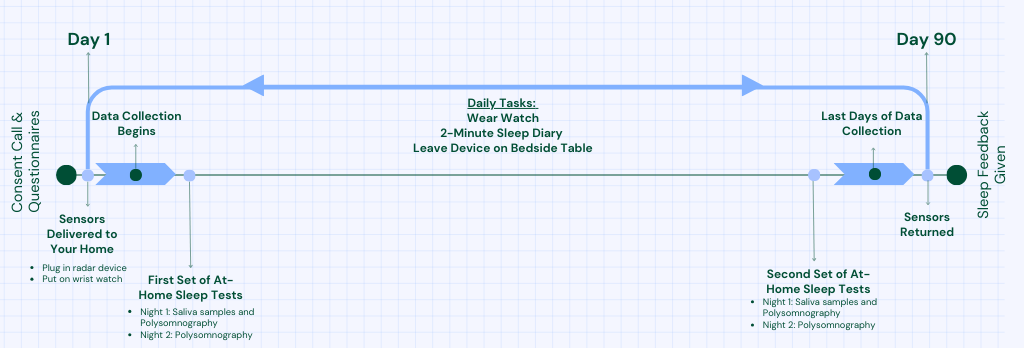
➡️Most of the study runs in the background of daily life.
• Daily sleep diary for 90 days: 1-2 minutes
• Wearing a wrist-worn activity monitor for 90 days
• Having a radar-sensor plugged in beside your bed for 90 days
• Sleep tests: saliva sample testing and polysomnography (two consecutive nights at the beginning of the study and two at the end).
Why might I choose to take part?
This study is not designed to provide direct personal benefit or treatment, but to validate low-burden methods to support future research and care approaches that are less disruptive and easier to fit into everyday life. At the end of the study, you will receive a summary on your sleep data.
➡️ If this sounds manageable, you can read full details below.
Research Study Information Sheets
Study Title: Ambient and Passive Collection of Sleep and Circadian Rhythm Data (AMBIENT-BD)
Thank you for your interest in our research study. Please read this
information sheet carefully. Take your time to read it and don’t feel
under any pressure to decide right away. It is important for you to
understand the study fully before you decide to participate or not. If
anything is unclear to you, or if you have any questions at all about
the study, please don’t hesitate to get in touch with us by email (ambientBD@mu.ie).
Ambient-BD is a research study that aims to investigate sleep and
circadian rhythms. It is funded by the Wellcome Trust and will run from
2023-2028. Ambient-BD is a joint project between Maynooth University and
the University of Edinburgh. You are invited to participate in the first
part of the study that will be carried out at Maynooth University.
Why are we doing this research study?
Circadian rhythms are changes in physiology and behaviour that follow a 24-hour cycle. For example, the daily rhythm in body temperature, alertness and the sleep wake cycle are all examples of circadian rhythms. In fact, almost every cell in the human body is regulated by a circadian clock, and this does not depend on the light dark cycle or the timing of food or exercise. Circadian timing has been “hard-wired” into our physiology by evolution so that humans have 24-hour rhythms by default.
Deviation from this 24-hour rhythm is associated with detrimental effects on health and well being, and particularly for mental health. This might occur through irregular lifestyles, such as shiftwork, but many diseases are also associated with disturbed circadian rhythms especially neuropsychiatric conditions. People with bipolar disorder show signs of disrupted control of 24-hour rhythms such as problems with sleep timing and mood swings. The overall aim of Ambient-BD project is to investigate the reasons for this, but in order to do that, we need to validate methods that allow us to measure circadian rhythms.
The best method for measuring sleep is polysomnography (PSG), a test that monitors brain and heart activity and movement while people sleep. PSG can only be used to monitor sleep for 1-2 nights, and is not suitable for routine sleep assessment. The timing of sleep can be assessed by measuring increases in a brain hormone called melatonin that increases in the hours before bedtime. This test is called a “Dim Light Melatonin Onset (DLMO)” test and involves measuring how quickly the melatonin levels in your saliva increase around bedtime.
In Ambient-BD we will develop and test new ways to measure rhythms
using radar sensors, and compare them to PSG and DLMO.
Why am I being asked to take part in this research study?
We have asked you to take part because you are a healthy adult with a diagnosis of bipolar disorder.
To participate you must be:
- Fluent in English and capable of giving signed, informed
consent
- Aged between 18-50
- Resident in Ireland
- Willing and able to install sleep sensors in your bedroom and to wear a wrist worn accelerometer
- Willing to wear polysomnography sensors on four separate nights during the 3-month study duration
- Willing for researchers to visit your home
- Willing to collect multiple saliva samples over 8 hours
- Have access to a mobile phone and internet
- Have a diagnosis of BD (DSM-5 criteria) with at least one previous manic or hypomanic episode
- Willing to have a short online interview with a member of the Ambient-BD team to have your diagnosis confirmed
- Clinically euthymic (no episodes of depression, hypomania or mania) for at least three months at the time of enrolment in the study
Even if you meet the conditions above, you cannot take part if you have:
- History of allergy or any skin condition that might be exacerbated by exposure to wristwatch straps and electrode paste
- Chronic disease (eg diabetes, COPD, cancer, heart disease)
- Intellectual disability
- Pregnancy
- Shiftworker
- Use of recreational drugs or alcohol intake that exceeds HSE recommendations (< 11 drinks per week for women, < 17 for men)
- Any disability that might affect sleep or the ability to collect
saliva samples in dim light or sleep in PSG sensors
- Ever sleep with a pet or a child. Because of their small size it is difficult for the radar sensor to detect your sleep while they are there. It is possible to assess sleep if an adult sleeping partner is present
- Have any intention to travel across meridians (time difference more than 2 hours) during the 3-month study period. This is because “jetlag” disrupts your sleep
Do I have to take part?
It is important to know that you do not have to take part in this
study if you do not wish to. You can change your mind about
participating in this study at any time, even after the study has begun.
If you decide that you do not want to participate, this will have no
effect on your or their current or future participation in any other
research studies. You do not have to provide a reason for deciding not
to participate or changing your mind. If you wish to opt out at any
point, please contact the research team (Study email: ambientBD@mu.ie), and we
will organise this for you.
What happens if change my mind about participating during the study?
You can withdraw at any time and without giving a reason. If you
decide to do so, we will immediately remove all of your data from the
study, including your sensor, sleep and questionnaire data. Electronic
copies of data will be overwritten, and hard copies will be destroyed by
incineration. Biological samples will be destroyed by
incineration.
How will the study be carried out?
The studies will be carried out as you undergo your usual activities over 3 months. A researcher will fit the sensors for PSG and to show you how to collect saliva samples and you will set up the bedroom sensor and wristwatch yourself. We will always give you instructions and all materials and equipment needed to complete the study and we will always be available to answer any questions you have about the study.
You will be asked to do the following tasks:
Wear a wrist-worn activity monitor (like a Fitbit) at all times (day and night) for 3 months. You will need to remove the monitor for showering or swimming, and put it back on as soon as possible afterwards. The device will monitor movement and light exposure continuously throughout the day and night.
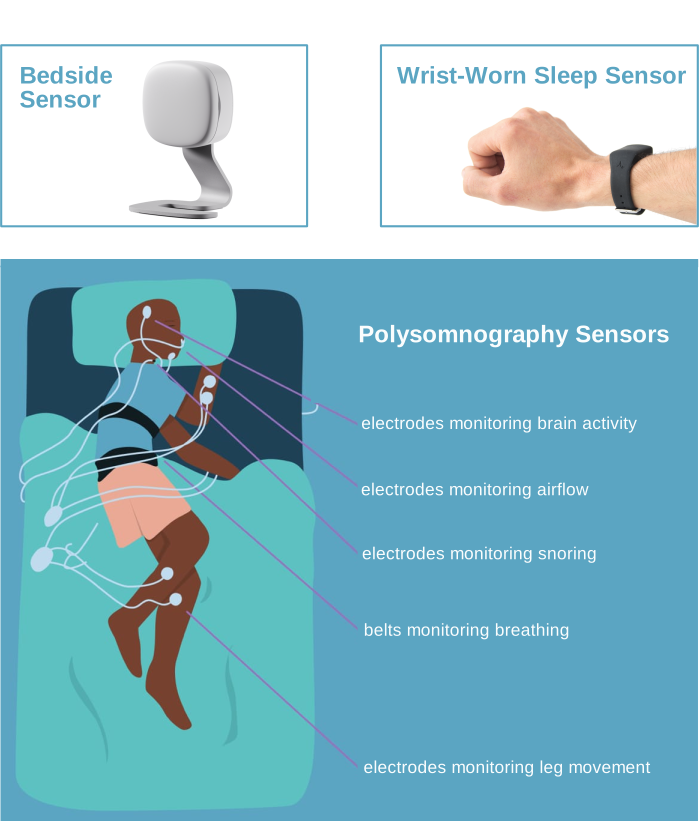
Fit a bedside sensor that monitors movement and environment in your bedroom for 3 months (see image below). The sensor records the following information:
- Movement
- Room temperature
- Sound in decibels
- Light
This sensor uses radar to monitor movement and we can use this information to design algorithms that can guess whether you are awake or asleep. We cannot tell what you are doing when you are awake. It records noise levels, not sounds or voices and ambient light. This sensor transmits data via the internet to a cloud platform where we can download your data.
The sensor has its own internet connection and you will not be able to download the data or access the sensor controls. It is unobtrusive and makes no sound, and has no display. If you go on holiday or stay somewhere else overnight, we will ask you to bring their bedside sensor, if possible. You will need to keep the modem and the sensor plugged into the mains at all times to power the sensor.
Complete some questionnaires about your health, lifestyle and sleep. The questionnaires will be completed at three time points during the 3-month study. Questionnaires will take approximately 10 minutes each to complete. You will need to keep a sleep diary for the 3 month study period.
Perform a melatonin test that will involve collecting saliva samples every 30 mins for 6 hours before bedtime and 2 hours after bedtime. This is called a “Dim Light Melatonin Onset (DLMO)” test and it measures how quickly the melatonin levels in your saliva increase at bedtime. You will need to do this once at the beginning and once at the end of the study. You will receive instructions from a trained researcher on how to collect these saliva samples and we will provide you with saliva collection kits. Melatonin is a hormone of darkness and light will surpress it straightaway. For this reason, the test must be performed in dim light and we will help you to adjust the light levels in your home for that. During the test, you will be allowed to read using a booklight that we will provide, and use screens at low light intensity. You can eat and drink during the test but not leave the dim-lit area so you will need to make sure you have any food that you need in the room where the test will take place.
Complete a Polysomnography Sleep Test for 2 nights at the beginning and end of the 3-month study. This will happen at the same time as the melatonin test. Researchers will visit your home each night and fit the following sensors:
- A nasal cannula to monitor airflow
- A control unit strapped to your chest
- ECG sensors to monitor heart rate and rhythm
- Straps to monitor chest and upper abdominal wall movement.
- Oxygen saturation sensor worn on the finger
- Skin sensors to monitor muscle tone in your chin, leg, chin and eye
You will need to sleep overnight wearing all of these sensors and then remove them yourself the following morning.
When will I need to do all these tasks if I agree to take part?
The tasks in this study will be arranged at times that suit you. There will need to be 3 months where you are able to wear the wrist strap and use the bedside sensor continuously. It is no problem to take this items to another location if you need to travel during this time. During the 3 months you will need to have 2 days in month 1 and 2 days in month 3 that you are free to do the PSG and DLMO tests in your home.
After you have read this information sheet, and if you decide that the study is something you would still be interested in, we will have a short conversation (in person, by phone, MS Teams or email) to ensure that you are eligible to participate. This conversation is confidential and the information you give us at this time will not be recorded. If you meet the inclusion criteria, we will then send you information on what is involved and give you time to read this and to ask questions. Next we will ask you to meet again (in person or online, your choice) to give written consent to participate. Next you will need to have a screening PSG session to make sure that your sleep patterns are healthy before you can continue participating. If that is clear, then we will enroll you into the study and arrange a 3-month study window that suits you to participate. All tests will be carried out in your home and you must be happy for the researchers to visit to set up the PSG sensors and show you how to perform the melatonin tests. The researchers will be male or female trained scientists, but they are not medical doctors and you will not be offered any medical advice at any point during this study. You will have the names and contact details of the researchers who you can contact at any time during the study, should you have any questions. You will need to complete questionnaires about your heath, lifestyle and sleep at the beginning, middle and end of the 3-month study.
DMLO stands for Dim Light Melatonin Onset, this test will monitor the rate at which melatonin (a hormone that signals darkness) rises in your saliva as bedtime approaches. PSG stands for polysomnography, a test that monitors sleep by measuring brain and muscle activity.
To summarise, over the 3 months we will:
- record questionnaire data at three timepoints
- continuously record daily movement data using the wrist worn sensors, and the bedside sensor
- measure melatonin evening increase in saliva on and measure sleep by PSG on two occasions during the 3-months
Can the sensors record images?
No, the sensors only measure movement in space, none of them can
acquire images.
Can the sensors record what I am saying or other sounds?
No, the sensors record noise levels in decibels, they can’t identify
sounds or record speech.
Can the sensors identify my location?
No, none of our sensor have GPS or capacity to identify or record
their location.
Can the bedside radar sensors identify what I am doing?
The sensors record data on movement but it is not possible to
identify what someone is doing other then whether they are awake or not.
We apply algorithms to the movement data at each timepoint to classify
whether the person is asleep or awake – it is a binary variable, either
awake or asleep, nothing else. The data cannot be used to detect sexual
or any other activity nor would we ever attempt to detect anything other
than the classification of being awake or asleep.
Can the bedside radar sensor record data from my partner?
The sensors will only record data from you and not your partner (as
long as you are the person closest to the sensor). Your participation in
this study does affect your partner as we will record light, sound and
temperature data in their bedroom, and we ask you to make sure anyone
sharing your bedroom is happy for you to participate.
Are there any benefits to me if I take part in the study?
Medical advances depend on the goodwill of volunteers that participate in research studies, and we believe that you will benefit from knowing you are making a valuable contribution to finding ways to help people with bipolar disorder. We are very grateful to everyone that participates in our research.
You will receive data from the radar sensors that show how your own sleep patterns and the environmental conditions in your bedroom vary over 3 months. This will benefit you by helping you to understand more about how you sleep over a long period of time. We will give you this data for your own interest at the end of the study, but we are not medical doctors and we won’t be able to help you understand it.
In recognition of the time and effort it will take you to perform the PSG and melatonin tests on two occasions, we will give you a gift voucher of 150 euros when you have completed each test (300 euros in total)
We will not return the results of your melatonin tests, as these are
research data and it would be difficult to understand what they mean at
an individual level.
What if I already have problems with my sleep?
Our research requires participants to have healthy sleep so if you
already have a sleep problem you will not be able to participate.
What if you find any problems with my sleep?
Even if you think you have normal sleep and enrol in this study,
there is a possibility that the tests we carry out identify that your
sleep patterns are not what we expect to see in a healthy person. If
this happens, we will let you know and we will give you copies of the
data we collected. You will not be allowed to continue to participate in
the study at this point. We are not medical doctors, so we will not be
able to give you any advice but we will recommend that you discuss our
findings with your GP. We will give you copies of your data that you can
discuss with your GP.
Are there any risks to me or others if I take part in the study?
We have taken great care to identify and address any potential safety concerns, and we do not consider that taking part presents a risk to the participants but we do ask you to pay attention to the following sources of risk. Remember if you are unsure about anything, please feel free to contact our research team at AmbientBD@mu.ie
There is a small possibility that you might develop skin irritation or redness from the wrist worn strap or from the paste and tape used to attach the sensors to your skin in the PSG study, and we will ask you to be vigilant to this, and to remove the strap immediately and withdraw from the study if signs of irritation are detected. All the items we use are medical-grade and we do not anticipate skin irritation to be a serious risk. We will send you two test sensor stickers to wear on your chest for 24 hours before the test, so that participant prone to skin irriation do not progress to the full PSG.
There is a chance that the cables and wires of the sensors could be a trip hazard and we ask you to take care when moving near them and to make sure that all ends are tucked away.
The DLMO test is performed in dim light and we ask that you are especially careful not to trip or fall at this time.
What identifiable information about me will be used as part of this study?
With your consent, when we enroll you in the study, we will record your name, address and contact details (email and phone number). We will use your contact details to contact you about the research study, and not for any other reason. This data that can identify is highly confidential and will be destroyed when you have completed the study or in December 2026, whichever comes first.
As soon as you have enrolled in the study, you will be assigned a unique study ID code - this is called de-identification. Any information we gather from that point (sensor data, melatonin data, and questionnaire data) will be associated with the ID code and not with your name or contact details. This is not only for electronically stored data. For example, physical copies of questionnaires, your saliva samples will be labelled with your unique study IDs and not your name. Only the authorised research team at Maynooth University will have access to the ‘key’ that links your name to your ID code, and this information will be stored on an encrypted file on a password protected computer at Maynooth University. Neither your name nor ID code will be used when reporting the results of this research for publication or presentation; your contribution will be entirely anonymous. In this way, even the researchers working directly with your data will not know which participant it comes from; this link can only be made by retrieving the key.
The only reason we have a key at all is so that we can contact you to collect sensors and follow up with results, and we will destroy the key and all your contact information as soon as possible. This will be when you have completed the study, and the contact information of all participants will be destroyed in December 2026.
We ask for your permission to contact a family member or friend that you nominate in advance should we become concerned about your welfare during the study. We ask your permission to record and store their contact information for the duration of the study. We will destroy their contact information at the end of the study. We will only contact them if we are concerned for your welfare and not for any other reason. Even though you have given us their contact details, we will still ask your permission to contact them before we do that. We will ask you to confirm that you have checked they agree to be your named contact for the duration of this research project and for us to hold their name and contact details.
What other data will be collected about me during the study?
There are three types of data in this study (i) personal, identifiable data, (ii) personal data, (iii) anonymised data.
The personal, identifiable information that we will collect are your name, address and contact details (phone number and email address). These data can be used to identify you and are highly confidential. They will never be written on any of your research data items such as questionnaires or samples or sensor results. They will be linked to your research data via your study ID number and kept in a locked office or secure network that is separate to the research data stores. This means that even the Ambient-BD researchers will not be able to tell the identify of the participants from the research data they are working on. We will delete your identifiable data as soon as the study is over.
The research data that we collect about you includes personal information such as data on sleep, sensor data, lifestyle and health, age and sex, but these data are not unique to you and cannot be used to identify you without access to the ID code key. These data are de-identified until the end of the study (or Dec 2026 whichever is first) at which point all identifiable data are deleted and all personal data are anonymised. The personal research data will be identified only by an ID number and will be stored in a secure location on the MU server. De-identified data will not be shared with anyone outside the research team.
Anonymised data means that all connections to your identity have been
irretrievably destroyed and there is no way that anyone (not even the
researchers) can ever find out that information came from you. We ask
your consent to retain this anonymous information indefinitely and to
share it with other researchers and via scientific repositories.
Repositories are public databases that can be accessed by anyone and are
very important for progressing science and preventing other scientists
repeating work that has already been done. Releasing our research data
into the public domain like this means that science will benefit for
many years after our project has finished, and that the experiments do
not have to be repeated.
What will happen to my saliva samples at the end of the study?
All saliva samples will be retained by Maynooth University
indefinitely after anonymisation and may be shared with other
researchers interested in addressing the hypothesis of Ambient-BD. They
will not be made available for any other purpose. Unfortunately we
cannot ask for your explicit contest to participate in future studies,
since the samples will have been anonymised at this point. Instead we
ask for your consent in advance for your samples to be used in future
studies that address the importance of sleep and circadian rhythms.
Future studies will only be allowed to analyse biochemicals and hormones
in your saliva; we will never extract or analyse any genetic information
from your samples. We are not able to tell you now what these studies
will be, as they will involve the scientific techniques that will be
available in the future. Remember that the samples will be anonymised
and can’t be linked to you in any way.
What happens to my data and saliva samples if I decide to withdraw?
If you decide to withdraw from the study, then all data will be
deleted and saliva samples will be destroyed; nothing will be retained
for anonymisation in this case. You will be completely removed from the
study. If you withdraw we will ensure that our third party processor,
VitalThings deletes your de-identified data from the sensors, sex and
date of birth data. If you complete the study, your data will be
anonymised and it will not be possible to withdraw from the study after
this point.
Will my personal data and/or sensor data be used in future studies?
The data we collect will be anonymised once the sensors, samples and
questionnaires have been returned, so it will not be possible for
anyone, including the research team to identify the participants from
the datasets. With your consent, we will retain these anonymous datasets
indefinitely. These datasets may be used in teaching or research.
Will I have access to the data generated by future studies?
No. Following completion of the study or withdrawal from the study,
your identifiable personal information including your name, address and
contact details will be destroyed. All other data (sensor, melatonin and
questionnaire data) will then be anonymised (it will no longer be linked
back to you), and it will not be possible for us or anyone to identify
you. For this reason, we cannot return any of your results after
anonymization and you will not be able to withdraw, request access, or
to make any amendments after the data are anonymised. This anonymised
data will be held in Maynooth University and made available in public
repositories for indefinite open access.
Who will access my identifiable personal data as part of this study?
Only the authorised researchers named above, working in the research
team at Maynooth University will have access to your identifiable
personal data including your name, address, and contact details. All
other data (sensor data, age, biological sex, clinical information,
melatonin data and sleep data) are only identifiable by your unique
study ID. We will never label your questionnaires, saliva samples or
sensor data with your name or contact details. VitalThings, Novolytix
and onlinesurveys.ac.uk cannot access your identifiable information.
Only the research team at MU can ever find out your identify, and this
is only for the purposes of contacting you about the study. As soon as
the study is completed all your identifiable information will be
destroyed and there is no way that you can ever be linked to study data
again.
How will my privacy be protected?
Your personal information will be kept entirely confidential, and we will exercise our duties in handling your personal data as per the General Data Protection Regulation (GDPR). Protecting your privacy is extremely important to all the research team members at Maynooth University. Personal Identifiers, such as your name or email are never used to label your questionnaires, sensor data or saliva samples. All data will be stored on password protected files on a secure network in Maynooth University. No one outside of the research team in Maynooth University will have access to your name or contact information and all other data will be labelled with your unique study ID. Please note that even the members of the research team that are working on the study on a daily basis will not know from which participant the data came from. To find this out, they would need to access a controlled file that connects your study ID to your identity, and to do so would be a violation of the research undertaking agreement that they have signed with Maynooth University. You will be known only by your study ID number; we retain identifiable information only for the purposes of contacting you during the study period.
Although all measures will be taken to protect your privacy, there is a remote risk that a connection to your contact details could be made, e.g., through unauthorised access to servers or premises at Maynooth University. To minimise this risk, any files containing these data are password protected and have restricted access, or are in locked cabinets in locked offices. Any attempt to identify you in this manner would be a legal breach against the permitted use of the research data.
When you have returned the sensors, questionnaires, and samples, and
the study is complete, your contact details will be incinerated in the
case of written records, and electronic data will be reformatted or
overwritten by the research team at Maynooth University and all data
will be anonymous.
What is the lawful basis to use my personal data?
As part of the study your personal data will only be used for
scientific research which is in the public interests (Article 6 (e) and
Article 9( 2) (j) of General Data Protection Regulation (GDPR)).
What are my rights?
Under the GDPR, you are entitled to:
- The right to access to your data and receive a copy of it
- The right to restrict or object to processing of your data
- The right to object to any further processing of the information we hold about you (except where it is de-identified)
- The right to have inaccurate information about you corrected or deleted
- The right to receive your data in a portable format and to have it transferred to another data controller
- The right to request deletion of your data.
These rights to access to your data are forfeit in this study by the complete anonymisation of the data. Complete anonymisation is to protect the privacy and data security of the participants, but it also means that it is impossible for you to access your data for any reason. We will not record the identity of the participants that provided any specific item of data, so we will not be able to give you access to your data or to make any amendments.
It must be recognized that, in some circumstances, confidentiality of
research data and records may be overridden by courts in the event of
litigation or in the course of investigation by lawful authority. In
such circumstances the University will take all reasonable steps within
law to ensure that confidentiality is maintained to the greatest
possible extent.
Will it cost me anything if I agree to take part?
Other than the cost of your time, there are no costs to you
personally by participating in this research study.
Who is funding the study?
This project is funded by the Wellcome Trust (www.wellcome.ac.uk;
grant number 226944/Z/23/Z)
What happens if I wish to make a complaint?
If you have concerns or questions about any aspect of the study or if
you wish to make a complaint, please speak to the researcher you are
working with or contact the research team (AmbientBD@mu.ie) who
will do their best to assist you. If they are unable to answer your
question, please contact the Secretary of the Maynooth University Ethics
Committee at research.ethics@mu.ie or +353 (0)1 708 6019. Please be
assured that your concerns will be dealt with in a sensitive
manner.
Will I be contacted again?
We will not contact you again after all data, equipment and sensors
have been returned at which point we will destroy your name, address and
contact details.
Who has approved this study?
This study has been reviewed and received ethical approval from the
Biomedical and Life Sciences Research Ethics Sub-Committee (BSRESC) of
Maynooth University on 12/09/2023 (BSRESC-2023-36286). If you would like
more information about the ethics committee’s approval of this study,
please contact research.ethics@mu.ie.
Where can I get further information?
You can get further information from our research team
Ambient-BD Research Team,
Department of Biology,
Maynooth University,
Co. Kildare
ambientBD@mu.ie
The data processors for this study are the Ambient-BD Research Team
in Maynooth University.
The Data Controller for this research project is Maynooth University,
Maynooth, Co. Kildare.
Maynooth University Data Protection officer can be contacted at 17 Rye Hall Extension, Maynooth University, Co.Kildare
Maynooth University Data Privacy policies can be found at https://www.maynoothuniversity.ie/data-protection.